

In November, after the Creative Project meeting, we decided we wanted to base our performance on forgotten women. We started by looking at the book 'Bloody Brilliant Women' by Cathy Newman, which claimed to have a list of amazing forgotten women. However, after reading this, we all felt that even though this was a great starting point, we could all find some really wacky and wholesome women to base our performance on through our own research.
After a week of researching forgotten women, we came into rehearsal with three women each. We read them out to each other and came to a decision to start with three women; Annie Londonderry, Annie Edson Taylor and Lilian Bland, as these three women's stories were the most exciting to us as a company, and we could really picture how we could stage it and how we would show it to the audience.
At first we decided that we would only tell the three women’s stories, however after developing our framing device further, we felt that the audience would leave our performance feeling unsatisfied if there were two characters who’s stories were not told. Therefore we went back to our first meeting and finally decided on Edith Wilson and Mary Beale, as these stories were just too good not to tell.
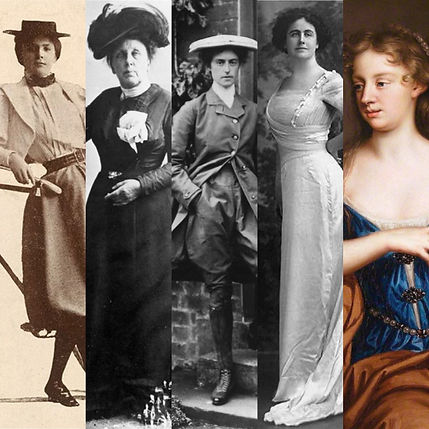
Annie Londonderry (1870-1947)
Below you'll find the research we carried out when looking into the lives of these women. This research was competed prior to the cancellation of the festival.

The First Woman to ride a bicycle around the world.
Annie Cohen Kopchovsky was a Jewish Latvian immigrant to the United States who became the first woman to ride a bicycle around the world.
Aged 24 she cycled away from her husband and three children to begin her journey which would last between the years 1894-95. It was an unexpected turn of events as she had never really ridden a bicycle before. She claimed her trip came about in order to settle a bet between two Boston businessmen on whether women were as physically capable as men. She would receive $10,000 if she could complete her journey in 15 months as well as earn $5000 along the way. However Annie was a skilled saleswoman, and there is little to no evidence that this wager was ever real, suggesting she may have invented it herself to sensationalise the story of her journey.
Her trip began in Boston and took her through America, Asia and Europe. She is noted to have travelled through a myriad of countries including France, Egypt, Israel, Singapore, China and Russia to name a few.
She kept her husband and family a secret and re-named herself Annie Londonderry
as part of an agreement with the Londonderry Lithia Spring Water Company of New Hampshire, who gave her $100 to change her name to advertise their company. Annie continued to sell various advertising space on her bicycle as part of her many money making schemes. Along her way Annie delighted crowds and reporters with various lies and exaggerations. She claimed to have been attacked by French bandits, hunted tigers and been shot in the arm at the frontlines of the Sino-Japanese war.
The story of Annie Londonderry’s trip around the world is certainly remarkable however many details are shrouded in uncertainty, partially due to her tendency for hyperbolizing. She died in obscurity in 1947, and her story remains largely overlooked and untold.
Edith Wilson (1872 - 1961)
the President's illness and disability from the American public as they didn’t want to worry the general public during such a challenging time.
Edith also took over a number of routine duties from October 1919 to the end of Wilson's term on March 4, 1921, Edith, acting in the role of First Lady and shadow steward, decided who and which communications and matters of state were important enough to bring to the bedridden president, Edith became the sole communication link between the President and his Cabinet. She required they send her all pressing matters, memos, correspondence, questions, and requests. Effectively this made her secretly the first female US President.
In 1921 Edith retired with Woodrow to their private home, where she nursed him until his death three years later. She spent her later years heading the Woman’s National Democratic Club board of governors, and she published her memoir in 1939. She died in 1961 with few realising her full story of her time in the White House.
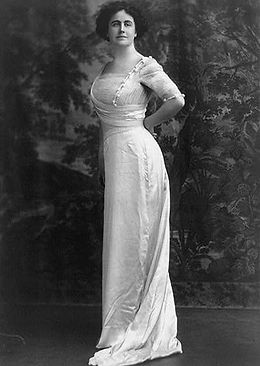
The first female president of the United States (sort of)
Edith Wilson, then bolling, was born in 1872 in Virginia. She was described to be a glamorous and tall figure. She became known around Washington, D.C. for driving her own electric car, and police officers reportedly stopped other traffic to let her pass through.
In December 1915 Edith married U.S. President Woodrow Wilson. She was first Lady during WWI and as such advocated for various homefront war efforts such as gasless Sundays, meatless Mondays, and wheatless Wednesdays to set an example for the federal rationing effort. Similarly, she set sheep to graze on the White House lawn rather than use manpower to mow it, and had their wool auctioned off for the benefit of the American Red Cross.
Edith Wilson submerged her own life in her husband's, trying to keep him fit under tremendous strain, and accompanied him to Europe when the Allies conferred on terms of peace. However in 1919 Woodrow suffered a stroke which left him bedridden and partially paralysed. Edith and others in the President's inner circle hid the true extent of
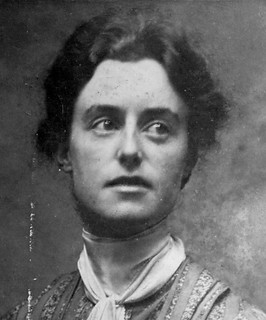
Lilian Bland (1878-1971)
on to the bottom of the plane as it lifted off the ground. She deduced that if the plane could carry the weight of 5 men, it would be able to carry the weight of an engine. Bland ordered an engine from the newly founded A.V. Roe Aircraft Company in Manchester for £100. She impatiently wanted to test the engine before its petrol tank was ready, so improvised, using an empty whisky bottle, and her deaf Aunt’s ear trumpet as an engine hose. However, this compromised the plane’s structure, due to the heaviness of the engine, and so Lilian had to make further adjustments and wait for the petrol tank.
Soon the plane was complete and after several attempts, the Mayfly flew to an altitude of 30ft in the air, and stayed in the air for a quarter of a mile. Bland was delighted and in disbelief that she had actually flown.
Lilian continued her experimenting for further flights and started a business, selling her biplanes. However, her father, worried about her precarious exploits, bought her a Model T Ford motor car. She taught herself to drive and became Ford’s first agent in Northern Ireland. She died in 1971 with her story largely unknown.
Built a working plane all by herself.
Lilian Bland was born in 1878 in Maidstone, Kent, from a long line of Irish descendants. She was unconventional: wore trousers, smoking, hunting, shooting, fishing, rode horses.
At aged 28, following her mother’s death, Bland moved to a family house, Tobercorran house, in Northern Ireland, with her father and her Aunt. She had a curiosity for aviation spending her days on remote Scottish islands photographing seabirds. Lilian attended the first official aviation meeting held in Blackpool in 1909, taking notes of the dimensions of displayed aircrafts. She also read numerous books and magazines, and set to work on building her own plane.
She began by constructing a glider made from bamboo, spruce, elm and ash. The controls were made of a bicycle handle-bar. Bland named it ‘The Mayfly’ due to her doubts surrounding its flying capability. Bland enlisted the help of four men to hold
Mary Beale (1633 - 1699)
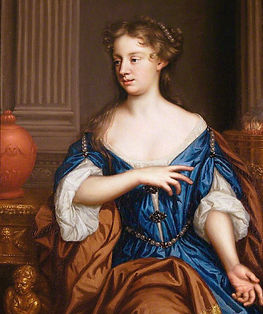
Britain’s first professional female painter
Mary Beale was born in Barrow, Suffolk in 1633. Her father was an amateur painter who taught her to paint when she was very young. In 1652, aged 18, she married her husband Charles Beale, a fellow amateur painter. Unusual for the time, throughout their marriage, Mary and Charles worked together as equals and as business partners.
Mary began her career by painting for people she knew, in exchange for small gifs. Charles kept a detailed record of everything she did as an artist, including what business transactions took place and what praise she received. Once Mary started painting for money in 1670, she knew that for a woman to become a successful painter, they would have to have a good reputation. So she carefully chose whom she would paint and used the praise from her circle of friends to build a solid reputation. Included in this select few was John Tilloston, a close friend of Mary’s who eventually became the Archbishop of Canterbury.
She preferred to paint in oil and water colours, and whenever she drew, she drew in crayon. She practiced her art by imitating other painters and due to her copying Italian masterpieces as practice, she ended up having an Italian air and style. Furthermore in 1663 she published a piece of instructional writing, named Observations, which began by critiquing how to paint apricots.
She made about two hundred pounds a year and even gave ten percent of her earnings to charity, but her income was still enough to support her family. And she did so. She was the breadwinner of the family.
Mary died on 8th October 1699. Not much is known about her death, other than she died in a house on Pall Mall, and was then buried under the communion table of St James’ Church, Piccadilly on 8th October 1699. Her tomb was then destroyed by enemy bombs during the Second World War. A memorial to her is within the church.
Annie Edson Taylor (1838-1921)
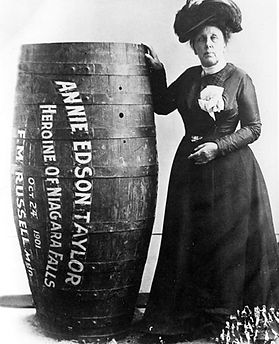
The first person to go down Niagra Falls in a barrel and survive.
Annie Edson Taylor was an American woman who led an extraordinary life. Having worked as a school teacher for many years, aged 62 she found herself in need of cash and stumbled across an interesting money making opportunity.
In 1901 she read about the Pan- American Exposition, which was a World’s Fair in Buffalo. It is said that is when she made the decision to do something she had never done before, but would surely make her money. Go down Niagra Falls in a barrell. She designed the barrel herself and named it The Queen of The Mist. It was built by a local beer keg making company and was stuffed inside with pillows and bits of mattress for protection.
There was a delay in the launching process as many did not want to help in the great feat deeming it a suicide mission. However, on the 24th October 1901, Taylor’s 63rd birthday, a cat was placed inside the barrel and sent over the edge of the waterfall. It survived and the barrel did not break. Now it was Annie’s turn.
The barrel was towed to the brink by a boat then released over the side. The fall only took a few minutes, and rescuers reached her very quickly.
She survived with only a few cuts and bruises, and word of her success as the first person to survive the trip was told to the throngs of spectators from a megaphone. She earned money from speaking about her experience and wrote a memoir. But her barrel was later stolen by her manager and most of the money was then spent on private detectives trying to locate it.
Her final years were spent posing for photographs with tourists at her souvenir stand in Niagara, trying to earn money from the New York Stock Exchange, re-constructing her plunge on film that was never seen, working as a clairvoyant, and giving electric and magnetic medical treatments. She died aged 82 in relative obscurity.